Surprise-Free Irrigation: What to Plan for Stable System Operation During the Season

Oleh Kovalchuk | Source: AgroPortal.ua.
Over recent years, I have had to evaluate dozens of active irrigation systems—ranging from relatively new projects to networks built back in the Soviet era. And almost everywhere, the exact same situation repeats itself.
A farm invests in modern irrigation machines, pumps, or pipelines, but fails to get the expected results. The machine falls short on water delivery, pressure fluctuations occur, electricity costs spike, and sometimes the system grinds to a complete halt due to an accident.
In most cases, the problem lies not within the irrigation machine itself. The root cause stems from small components that are frequently overlooked during system reconstruction or modernization.
In this post for the Variant Irrigation "Irrigation Practitioners Club" blog, I want to share my experience on how proper outfitting and configuration of auxiliary equipment can significantly increase network capacity, prevent water hammer, and ensure stable water delivery during the most critical period of the season.

You Must Start with the Main Pumping Station
When there are complaints about water shortages, the first thing to check is the main pumping station.
In many systems built decades ago, the pumps are physically intact but operate far below their original design parameters. Most frequently, the issue can be resolved by rewinding the synchronous electric motors and restoring them to their nominal power capacity.
In certain projects, this approach allowed for a nearly twofold increase in water supply without constructing a new pumping station. For a farm, this translates into the most critical asset—guaranteed water availability during peak load periods.
Water Hammer Is One of the Costliest Breakdown Risks in Irrigation
Many farmers underestimate the danger of water hammer. A single sharp pressure spike can compromise pipelines, gate valves, or pumping equipment. This is precisely why I always recommend implementing multiple layers of protection at once:
Safety Relief Valves
Pressure relief valves should be installed on the discharge line of the pumping station, configured to trigger when operational pressure is exceeded by approximately 10%.
Air Release Valves (Vantuz)
Air release valves must be positioned near the pumping station and, whenever possible, every 500 meters along the main pipeline.
In practice, DN 50 mm plastic air valves perform exceptionally well, offering a venting capacity on par with DN 100 mm metal models.

If You Cannot Measure It, You Cannot Manage It
Another typical issue is the complete absence of basic monitoring. When a farm cannot see actual pressure levels or water flow rates, any decisions are made entirely by guesswork.
Therefore, a baseline monitoring kit must include:
- Pressure gauges at the main pumping station—for continuous monitoring of pump operating pressure.
- A master water meter—to track the total volume of water fed into the system.
- Water meters on the irrigation machines—to verify the actual application rate on a specific field.
- Pressure gauges on the machines—to ensure actual pressure aligns with design specifications.
Only under these conditions can you be absolutely certain that the machine is delivering the precise watering application rate you calculated.

Often the Problem Is Not the Machine, But the Nozzle
When a grower notices non-uniform watering, they usually suspect a mechanical malfunction in the machine. However, very often the reason is much simpler—clogged nozzles.
Because of this, mesh filters with a mesh size of up to 2 mm must be installed on every irrigation machine. This is an inexpensive solution that prevents far greater financial losses down the line.
Fertigation: How to Get More out of Your Existing System
A modern irrigation machine can do more than just deliver water; it can also serve as a tool for fertilizer application. To achieve this, it is worth integrating a fertigation system at the central pivot cart or the machine tower.
From my own experience, piston dosing pumps yield the best results. They ensure high precision when applying UAN (liquid nitrogen fertilizer) and other liquid nutrients, allowing for more efficient use of every cubic meter of irrigation water.
A Diesel Generator Without Fuel Monitoring Is Always a Risk
If your irrigation machine is powered by a diesel generator, I highly recommend installing fuel level sensors. This allows you to monitor actual diesel consumption remotely and eliminate unproductive losses.
Special Attention—Linear Move Machines
For linear move irrigation machines, I recommend utilizing a dual-connection system via two flexible hoses. The main advantage of this setup is the ability to switch between hydrants without interrupting the water supply.
As a result, you get:
- continuous watering;
- zero downtime;
- minimized water hammer risks within the main pipeline.
Conclusion
Over my years working with irrigation systems, I have become convinced that a project's efficiency is determined by more than just the irrigation machine itself. System reliability is forged by dozens of minor technical decisions—from a properly tuned pumping station to a simple pressure gauge or air release valve on the pipeline.
It is these elements that most frequently dictate whether a farm will achieve stable watering at the most critical moment of the season, or face breakdowns, excessive power costs, and under-realized yields.
Therefore, I always recommend starting irrigation modernization not with the purchase of new hardware, but with a comprehensive audit of the entire system.
Oleh Kovalchuk, Head of the Irrigation Department for the "Prydniprovskyi" cluster at Kernel.
Responsible for 2,831 hectares of active irrigated land and a team of 43 qualified employees. Over 21 years of experience in irrigation operations.


Other entries
 28.05.2026
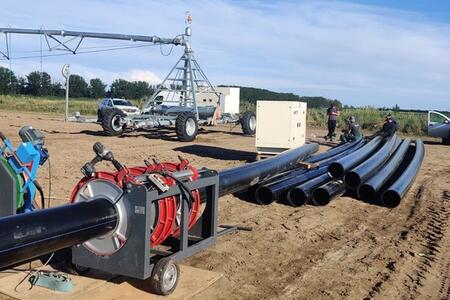
Irrigation Pipeline Networks: Where Farmers Most Often Lose Money on Operations
28.05.2026
Irrigation Pipeline Networks: Where Farmers Most Often Lose Money on Operations
 25.12.2021
Income of $ 3 400 per hectare: the case of irrigation in Hors-AGRO
25.12.2021
Income of $ 3 400 per hectare: the case of irrigation in Hors-AGRO
 27.04.2026
Error-Free Irrigation: Which Type of Center Pivot or Linear Machine Delivers Maximum Efficiency
27.04.2026
Error-Free Irrigation: Which Type of Center Pivot or Linear Machine Delivers Maximum Efficiency
 29.01.2026
Irrigation in Ukraine 2026: Prices, competition for water, state support and new irrigation technologies
29.01.2026
Irrigation in Ukraine 2026: Prices, competition for water, state support and new irrigation technologies
 25.12.2021
How to start an irrigation system from scratch?
25.12.2021
How to start an irrigation system from scratch?
 02.04.2026
Irrigation: How to Take the First Step Toward a Predictable and Profitable Business
02.04.2026
Irrigation: How to Take the First Step Toward a Predictable and Profitable Business

